
The accounting profession is experiencing its biggest technological shift in decades. Instead of spending countless hours digging through tax codes, Chartered Accountants (CAs) and CA students now have a dedicated artificial intelligence assistant to do the heavy lifting.
The Institute of Chartered Accountants of India (ICAI) has launched a game-changing tool tailored specifically for the profession: CA GPT. Unlike generic AI tools, this platform is trained on official ICAI study materials, accounting standards, and Indian regulatory frameworks.
If you want to know how to leverage ICAI’s CA GPT from start to finish, this detailed guide covers the entire journey.
What is ICAI CA GPT?
CA GPT is an AI-powered conversational platform developed by ICAI, available at ai.icai.org. It is not just one chatbot, but a catalogue of over 20+ specialized GPT models.
These models are categorized into specific domains like Direct Taxes, GST & Indirect Tax, Auditing & Assurance Standards, and Corporate Laws. Because it is built by ICAI, the responses are highly contextual to the Indian financial and regulatory ecosystem, making it a reliable digital assistant for both practicing CAs and students.
Step 1: Getting Started and Logging In
Accessing the platform is strictly reserved for the CA fraternity. The general public cannot use it, which ensures the tool remains highly specialized and secure.
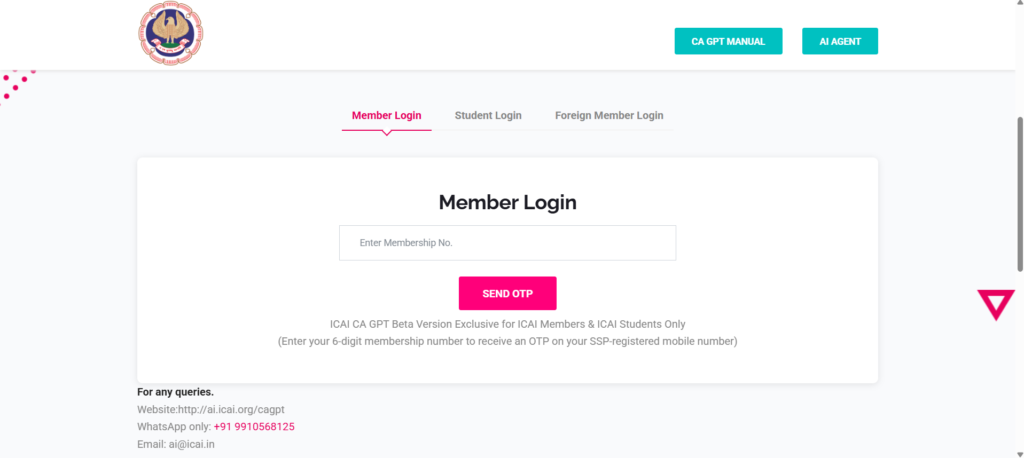
- Visit the Portal: Go to the official ICAI AI portal.
- Authentication: You can log in using your ICAI membership number (for practicing or industry members) or your student registration number (for CA Foundation, Inter, or Final students).
- Daily Allowances: As of the latest 2026 updates, users receive 20 free prompts per day. There is also a premium tier available for ₹499/month, which provides unlimited access and API integration for CA firms.
Step 2: Automating Complex Tax & Compliance Research
One of the biggest time-sinks for a CA is researching case laws, circulars, and tax updates. CA GPT simplifies this dramatically.
By selecting the “GST and Indirect Tax” or “Direct Taxes” GPT, you can ask highly specific questions. For instance, you can type, “Summarize the key changes in GST regulations for 2024-2025 regarding input tax credit”. The tool will instantly provide a structured answer based on official circulars and notifications. It eliminates the need to manually browse through endless government portals.
Step 3: Rapid Financial & Annual Report Analysis
Reviewing 100-page annual reports for peer benchmarking or audit preparation is exhausting. ICAI’s CA GPT is exceptionally good at financial analysis.
You can use the tool to extract critical insights from complex documents. By providing financial data, you can ask the AI to calculate and interpret debt-to-equity ratios, analyze liquidity trends, or break down a company’s cost structure. It is reported that mid-sized CA firms have reduced their annual report review time by up to 60% using these capabilities.
Step 4: Enhancing Audit Workflows
Audit quality and compliance with standards are non-negotiable. Using the specific “Auditing & Assurance Standards Board” GPT, you can ensure that your audit plans are watertight.
Before starting an engagement, you can prompt the tool to list the disclosure requirements under a specific Ind AS. You can also use the Audit Risk Simulator to model fraud scenarios or create comprehensive compliance checklists based on the latest regulatory changes.
Step 5: A Game-Changer for CA Students
CA GPT isn’t just for qualified professionals; it is a massive asset for CA students. Students can use the tool as a 24/7 personalized tutor.
If a student is struggling with a complex concept in Strategic Financial Management or Corporate Law, they can ask the AI to “Explain this concept in simple language as if I am a beginner”. Because the AI is trained directly on ICAI’s study material, the answers are perfectly aligned with the syllabus, helping improve exam readiness and concept clarity. Data from 2026 even shows a 12% improvement in pass rates for AI-assisted student cohorts.
Best Practices for Using CA GPT
To get the absolute best results from this tool, keep these expert tips in mind:
- Write Perfect Prompts: The AI is only as good as your instructions. Provide clear context, specify the exact task, and state the format you want (e.g., “Give me a tabular comparison between Section 43B and Section 40A”).
- Maintain Client Confidentiality: Never input sensitive client data like PAN numbers, exact names, or highly confidential financial figures.
- Always Cross-Check: While CA GPT is highly accurate and built on reliable data, it is still an AI. Always verify critical dates, sections, and case laws before submitting final reports or advising clients.
Final Thoughts
The launch of CA GPT by ICAI proves that the future of accounting is undeniably digital. By automating research, accelerating financial analysis, and acting as an interactive study guide, this tool allows Chartered Accountants to focus more on strategic advisory and less on tedious manual tasks. Whether you are an experienced partner at a firm or a student preparing for your finals, making CA GPT a part of your daily routine is a brilliant career move.